Unleash 52 Haunted Designs with Spooky Houses
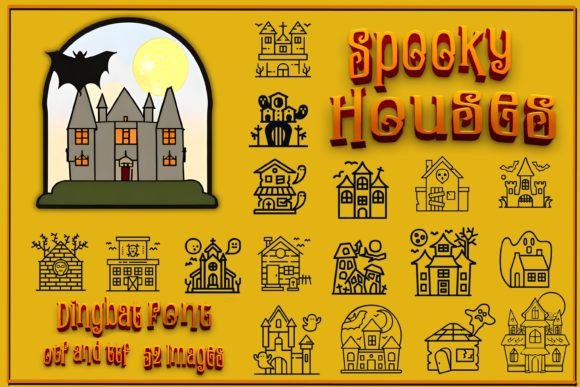
When October rolls around, the pressure mounts for designers and content creators to deliver that specific, chilling aesthetic. We often find ourselves scrolling through endless libraries of stock photos or generic clipart, searching for that perfect haunted mansion to grace a party invitation or a social media post. If you are looking for a creative font that transcends standard typography and steps into the realm of illustration, the Spooky Houses doodle font is a fascinating tool to explore. It is not just a typeface; it is a collection of 52 distinct, spine-tingling architectural illustrations ready to be customized.
At its core, Spooky Houses operates as a dingbat font. For those new to the term, a dingbat is a font where typing a letter on your keyboard does not produce a character like "A" or "B," but instead inserts a specific image—in this case, a haunted home. This particular collection offers a massive variety of silhouettes. You will find towering Victorian mansions with widow’s walks, crooked shacks, decrepit cottages, and modern homes with a ghastly twist. The line art style is intricate enough to look professional but bold enough to maintain visibility even at smaller sizes.
Why Visuals Drive Engagement
In the world of brand identity and marketing, visual consistency is king. Whether you are a blogger creating a Halloween roundup, a small business owner designing seasonal packaging, or a hobbyist working on a scrapbook, the assets you choose dictate the mood. Spooky Houses offers a unique advantage here because it functions as a design asset library embedded within a font file. You do not need to switch software or import heavy vector files; you simply change your font selection and type the corresponding letter. This workflow efficiency is invaluable for entrepreneurs and marketers who need to produce high-quality content quickly.
The visual personality of these illustrations leans heavily into the classic "spooky" aesthetic. There is a hand-drawn quality to the lines that feels organic and slightly unsettling, which is exactly what you want for this genre. Unlike a rigid sans serif font or a formal serif font, these illustrations evoke an immediate emotional response. They tap into the nostalgia of classic horror films and childhood ghost stories. Using these graphics can significantly boost audience engagement on platforms like Instagram or Pinterest, where visual distinctiveness stops the scroll.
Practical Applications for Creators and Brands
The versatility of Spooky Houses lies in its ability to adapt to different mediums. Because the images are generated as text, they behave differently than standard image files, which opens up creative possibilities for web design and print design.
Digital and Social Media
For social media graphics, these dingbats are incredibly useful. You can type out a row of houses to create a custom border for an Instagram story or use a single, large house as a focal point for a Facebook event cover. Since you can color the font just like any text, you can instantly match the houses to your brand’s specific Halloween color palette—perhaps a neon green for a retro vibe or a deep crimson for a gothic aesthetic. This level of customization ensures your visual hierarchy remains intact; the image supports the message rather than clashing with it.
Print and Stationery
In the realm of editorial design and stationery, Spooky Houses shines. Imagine designing a Halloween party invitation: you can set the background to a dark, moody texture and overlay the house illustrations in white or orange. This creates a striking silhouette effect. It is also perfect for greeting cards, postcards, and planners. If you sell printable PDFs or physical stationery, these assets allow you to create professional-looking products without commissioning custom illustration work. The consistency of the line weight across all 52 houses ensures that if you combine them into a cityscape scene, the brand perception remains cohesive and polished.
Integration and Font Pairing
One of the most common questions in modern typography is how to pair display elements with body text. When using a graphic-heavy element like Spooky Houses, the surrounding typography needs to breathe. Because the houses are detailed, they act as high-contrast focal points. You should avoid pairing them with a highly decorative script font or an overly complex handwritten font for the main text, as this can lead to visual clutter.
Instead, consider a clean, legible sans serif font for your headers and a simple, readable serif for body copy. This contrast ensures that the "readability" of your message remains high. The Spooky Houses illustrations serve as the "seasoning" of the design—they add flavor and character—but the standard typography provides the structure. For example, if you are creating a flyer for a haunted attraction, use a bold, modern sans serif for the event details and sprinkle the house dingbats as decorative bullet points or section dividers.
Strategic Evaluation for Your Project
Before integrating any new premium font into your workflow, it is wise to evaluate its fit. Here are a few practical steps to determine if Spooky Houses is the right asset for your upcoming project:
- Assess the Tone: Does your project require a whimsical, cartoonish Halloween vibe, or a terrifying, realistic horror aesthetic? Spooky Houses leans toward a classic, illustrative spookiness. If you need hyper-realism, this might not be the match.
- Check Scalability: Test the font at the size you intend to use it. Since it is a vector-based font, it should scale well, but always check how the line details look on small mobile screens versus large printed posters.
- Licensing Needs: If you are a small business owner or marketer, ensure the license covers your intended use. Most standard licenses cover web and print, but if you are creating "print-on-demand" merchandise (like t-shirts or mugs), verify that the commercial license allows for this.
- Color Testing: Experiment with coloring the images. Try using a gradient fill or overlaying a texture inside the letters (a technique possible in software like Photoshop or Illustrator) to see how it interacts with the line art.
Elevating Creative Assets
In a saturated market, unique design assets can set you apart. Stock imagery is often overused, but a custom arrangement of dingbat characters can feel entirely original. By typing out different combinations of the 52 available houses, you can create a unique skyline that no one else has. You can layer them, overlap them, and resize them to build depth.
This approach is particularly effective for packaging design. If you are a crafter selling homemade candles or soaps with a Halloween theme, wrapping your product in a custom pattern made from these house icons elevates the perceived value of the product. It moves the design from "homemade" to "professionally branded." The ability to change the background image behind the font also allows for creative layering—imagine a house silhouette revealing a starry night sky or a burning orange sunset behind it.
Ultimately, Spooky Houses is more than just a novelty; it is a versatile tool for anyone looking to inject personality into their seasonal projects. It bridges the gap between typography and illustration, offering a practical solution for creative professionals